
10 Questions to Ask Any Peptide Supplier Before You Buy
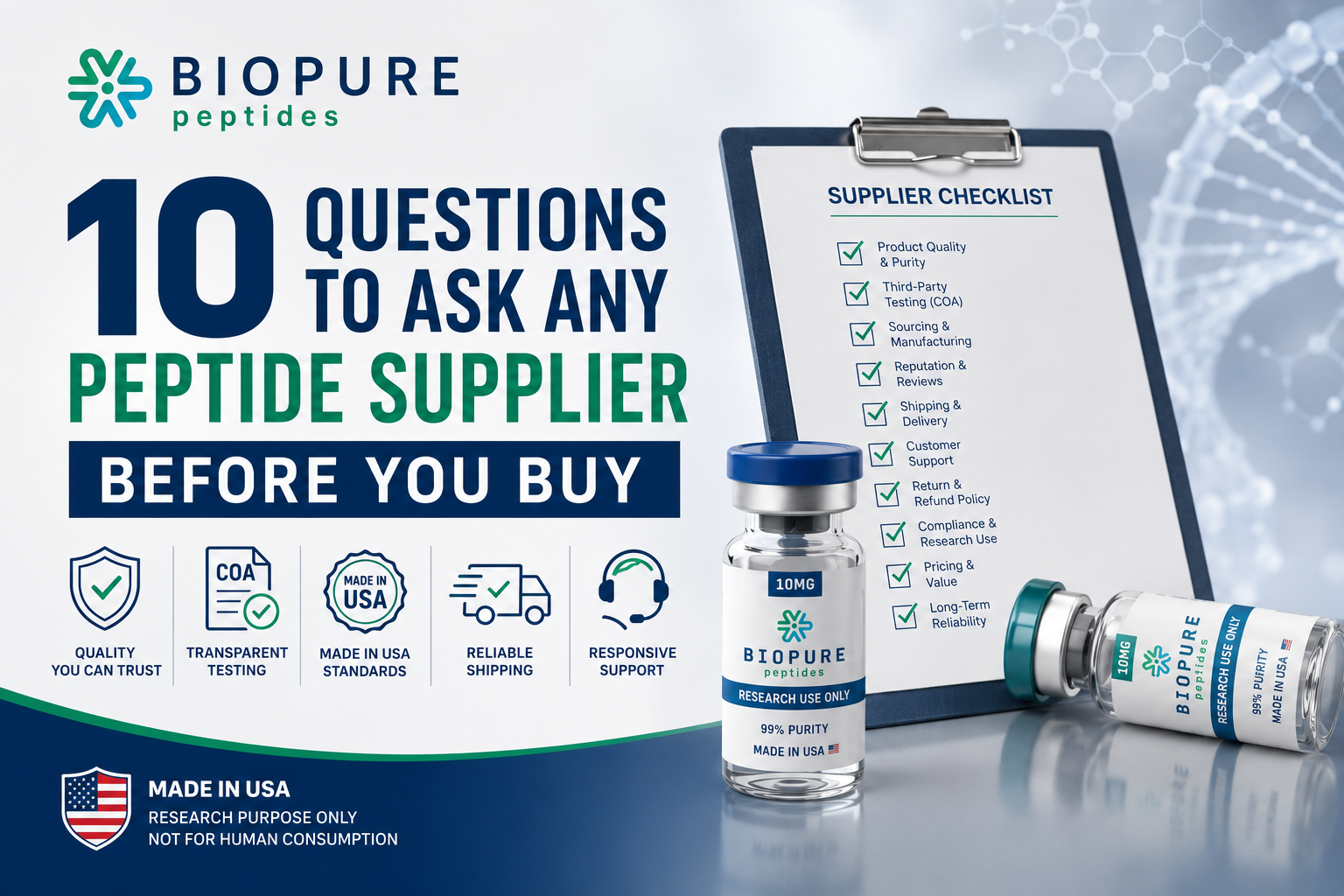
At BioPure Peptides, we get a version of the same question almost every week: how do I tell one supplier from another?
It’s a fair question, and a hard one. Nearly every peptide website makes the same claims. High purity. Third-party tested. Lab grade. The words are free, and there is no shortage of companies willing to use them. What separates suppliers isn’t what they say on a homepage - it’s what they can produce when someone asks a specific question.
So we wrote down the questions. These are the ten we would ask if we were on the other side of the transaction, along with what a substantive answer sounds like and what should give you pause. Ask them of us. Ask them of the vendor you’re currently using. Any supplier that manufactures what it sells should be able to answer all ten without hesitating.
1. Where are these peptides actually synthesized?
Start here, because a large share of the market is a relabeling operation. Peptide is synthesized overseas in bulk, shipped in, filled into vials domestically, and sold under a brand name that never touches the chemistry.
“Made in the USA” on a label can mean the box was printed in Ohio. What you want to know is where the synthesis happened, where the API originated, and whether the supplier can name the facility.
Green flag: A direct answer about the manufacturing facility, its location, and its certifications. Red flag: Vague geography, “we work with a network of partners,” or an answer that shifts from manufactured to distributed under follow-up.
2. What certifications does the manufacturing facility hold?
Certification is where marketing language runs into an audit trail. WHO/GMP and ISO 9001 certifications mean an outside body has examined documented process control - batch records, deviation handling, equipment qualification, personnel training. They are not badges a company can award itself.
Our peptides are produced in a WHO/GMP and ISO 9001 certified facility. That is a checkable claim, which is the entire point of making it.
Green flag: Specific standards named, with the certifying scope explained. Red flag: “GMP-quality,” “GMP-adherent,” or “manufactured to GMP standards.” Those phrasings exist specifically because they aren’t certifications.
3. Can I see the Certificate of Analysis for the exact lot I’m receiving?
Note the wording: the exact lot. A representative COA from a batch produced eighteen months ago tells you very little about the vial in your hand.
A COA should identify the product and lot, state the analytical methods used, and report results with acceptance criteria - not just a purity percentage floating on its own. It should be legible, dated, and traceable back to the testing entity.
Green flag: Lot-specific documentation available on request, or published per product. Red flag: No COA. A COA with the lot number removed. A COA that is a JPEG of a table with no letterhead, method, or signature.
4. What analytical methods were used - and what do they each confirm?
This is the follow-up that separates suppliers who read their own COAs from ones who forward them.
HPLC tells you what percentage of the material is your target peptide versus related impurities. Mass spectrometry confirms the molecular weight - that you have the right compound, not merely a pure one. Together they answer two different questions, and neither substitutes for the other. Depending on the product, water content, residual solvent, and endotoxin testing may also be relevant.
Green flag: A supplier who can explain what each test is for and why both matter. Red flag: “99% pure” with no method attached. Purity is meaningless without the assay that produced it.
5. Is that purity figure HPLC purity or net peptide content?
The most consequential question on this list, and the one asked least often.
HPLC purity describes the peptide fraction of the material - how much of the peptide present is your target sequence. Net peptide content describes how much of the total mass in the vial is actually peptide. The remainder is typically counterion salt (often TFA from purification) plus residual water.
Those two numbers can differ substantially. A vial can be legitimately 99% pure by HPLC and still be well under that by mass. Neither figure is dishonest - but a supplier quoting only the flattering one, when a cheaper competitor’s price looks impossible to beat, is worth a second look. Price per milligram of peptide is not the same as price per milligram of powder.
Green flag: The supplier knows the distinction instantly and can tell you which figure they publish. Red flag: Confusion, deflection, or a sales rep who has never heard the term.
6. Who performs the testing?
In-house QC and independent third-party verification serve different purposes. In-house testing is continuous and catches process drift. Third-party testing removes the manufacturer’s own interest from the result.
Strong suppliers do both, and are candid about which is which.
Green flag: Named laboratories, or at minimum a clear statement of what is tested internally versus externally. Red flag: “Third-party tested” as a slogan, with no lab ever named and no report ever produced.
7. How is the product handled between synthesis and my door?
Lyophilized peptides are stable - that’s why they ship as powder rather than solution - but stability is not indifference. Storage temperature, light exposure, humidity, and how long a vial sat in a warehouse all matter, as does packaging for the season and the destination.
Green flag: A specific answer about storage conditions, packing method, and shipping timelines. Red flag: Pre-reconstituted product sold as a convenience. Solution is the least stable form and the hardest to verify.
8. Does the supplier accept returns, and what happens if a vial arrives damaged?
Policy questions feel mundane next to analytical chemistry, but they are diagnostic. A company that manufactures its own product and stands behind it writes a policy it can afford to honor. A company running thin margins on imported material writes a policy designed to make claims difficult.
Green flag: A published, findable policy with an actual human process behind it. Red flag: No policy page. All-sales-final language. A support channel that is a form and nothing else.
9. Can I reach a human being - and does that human know the product?
Call the number. See who answers, and see whether they can handle question five.
The peptide market has a long tail of storefronts with no staff, no address, and no phone. Those operations can disappear between your order and your next one, taking your documentation history with them. A physical address and a working phone line are low bars, and a surprising number of vendors don’t clear them.
Green flag: A real address, a real phone number, and staff who can discuss specifications rather than only order status. Red flag: Contact form only. No address. Chat support that can’t answer anything technical.
10. How does the supplier talk about intended use?
We’ve saved a compliance question for last, because it is one of the most reliable signals of how a company operates overall.
Research peptides are sold for laboratory and research use only. They are not approved for human or animal use, and they are not intended to diagnose, treat, cure, or prevent any condition. A supplier that respects that framing will decline to discuss administration, protocols, or outcomes - not because it’s unhelpful, but because doing otherwise misrepresents what the product is.
A vendor willing to disregard that line to close a sale has told you something about its priorities. Ask yourself what else it might be willing to disregard when nobody is asking.
Green flag: Clear research-use-only positioning, consistently applied. Red flag: Human-use claims, therapeutic language, or before-and-after marketing.
The short version
If you only have time for three, ask these:
- Where was this synthesized, and by whom? (Question 1)
- Can I see the COA for this lot, and which methods produced it? (Questions 3 and 4)
- Is that purity HPLC purity or net peptide content? (Question 5)
A supplier who answers those three well will almost always answer the other seven well. A supplier who stumbles on them is telling you the answer to all ten.
Our answers
We publish this list knowing it will be used on us, which is the point. BioPure Peptides manufactures in the United States in a WHO/GMP and ISO 9001 certified facility, tests to greater than 99% purity, and provides documentation on request. Our team is in Chandler, Arizona, and the phone number on this site reaches people who can discuss specifications, not just shipping.
If you want to put us through the ten questions, we’d welcome it. Call (888) 745-1505 or use our contact page - and if you’re weighing domestic manufacturing against a lower import price, our breakdown of why premium USA-made peptides cost more covers where that difference actually goes.
All products sold by BioPure Peptides are intended strictly for in-vitro laboratory and research use only. They are not for human or animal consumption. These statements have not been evaluated by the U.S. Food and Drug Administration, and these products are not intended to diagnose, treat, cure, or prevent any disease.