

Quick answer: The CJC-1295 Ipamorelin research history is really two separate stories. CJC-1295 is a modified fragment of growth hormone-releasing hormone (GHRH), a hormone isolated in 1982. Ipamorelin is a small synthetic peptide that acts on the ghrelin receptor, a target understood in stages from the 1980s to 1999. They came together in the lab because they act on different receptors in the same pathway.
Where did GHRH come from?
For years researchers knew the brain must send a signal telling the pituitary gland to release growth hormone (GH). They could not isolate it. In 1982, two groups, one led by Roger Guillemin and one by Wylie Vale, reported isolating and sequencing GHRH from tumor tissue that produced it in unusually large amounts.
The full molecule is 44 amino acids long. Follow-up work found that the first 29 amino acids kept most of the activity at the GHRH receptor. That 29-amino-acid fragment became the standard starting point for synthetic analogs.
Why is CJC-1295 a modified fragment, not the natural hormone?
Natural GHRH is broken down quickly by enzymes, which makes it hard to work with in a laboratory. Researchers built analogs on the 29-amino-acid backbone with a few amino acids swapped. These swaps were designed to improve stability while keeping receptor activation.
The best-known version has four substitutions. It appears in the literature as modified GRF (1-29), tetrasubstituted GRF (1-29) and CJC-1295 without DAC. A separate form, CJC-1295 with DAC (drug affinity complex), adds a chemical group designed to bind the blood protein albumin. The two forms are different molecules with different masses. Our product page says only that CJC-1295 is a “truncated peptide analogue” of GHRH, so the Certificate of Analysis is where you confirm which form is in the vial.
How was the ghrelin receptor found before ghrelin?
This part runs in reverse. In the late 1970s and 1980s, researchers led by Cyril Bowers reported that small synthetic peptides, such as GHRP-6, made pituitary cells release GH. These compounds did not act on the GHRH receptor. They were called growth hormone secretagogues, and their target was cloned in 1996 while its natural partner was still unknown.
In 1999, Masayasu Kojima, Kenji Kangawa and colleagues identified that partner in stomach tissue and named it ghrelin. The receptor is now called the growth hormone secretagogue receptor, or GHS-R1a, or simply the ghrelin receptor.
Where does Ipamorelin fit?
Ipamorelin is a synthetic peptide of just five amino acids, including non-natural building blocks. It was described in published cell and preclinical work in 1998 as a selective GH secretagogue. Those early reports noted that it released GH without the broader hormone changes seen with some older secretagogues. That selectivity is why it is often described as one of the more selective compounds in its class.
Why were the two studied together?
Earlier laboratory work had reported that a GHRH-type signal and a ghrelin-receptor signal together produced more GH release than either one alone. That is the basis for pairing an analog of each. The evidence is mostly cell and preclinical research, and it is still early. For a wider look at what “synergy” does and does not mean, see Peptide Blends vs Individual Stacks. For the receptor mechanics, see Tesamorelin and Ipamorelin: Two Receptors, One Cell.
| Molecule | Size | Target | Origin |
|---|---|---|---|
| GHRH (natural) | 44 amino acids | GHRH receptor | Isolated 1982 |
| CJC-1295 backbone | Built on the first 29 amino acids of GHRH | GHRH receptor | Modified synthetic analog |
| Ghrelin (natural) | 28 amino acids | Ghrelin receptor (GHS-R1a) | Identified 1999 |
| Ipamorelin | 5 amino acids | Ghrelin receptor (GHS-R1a) | Synthetic, described 1998 |
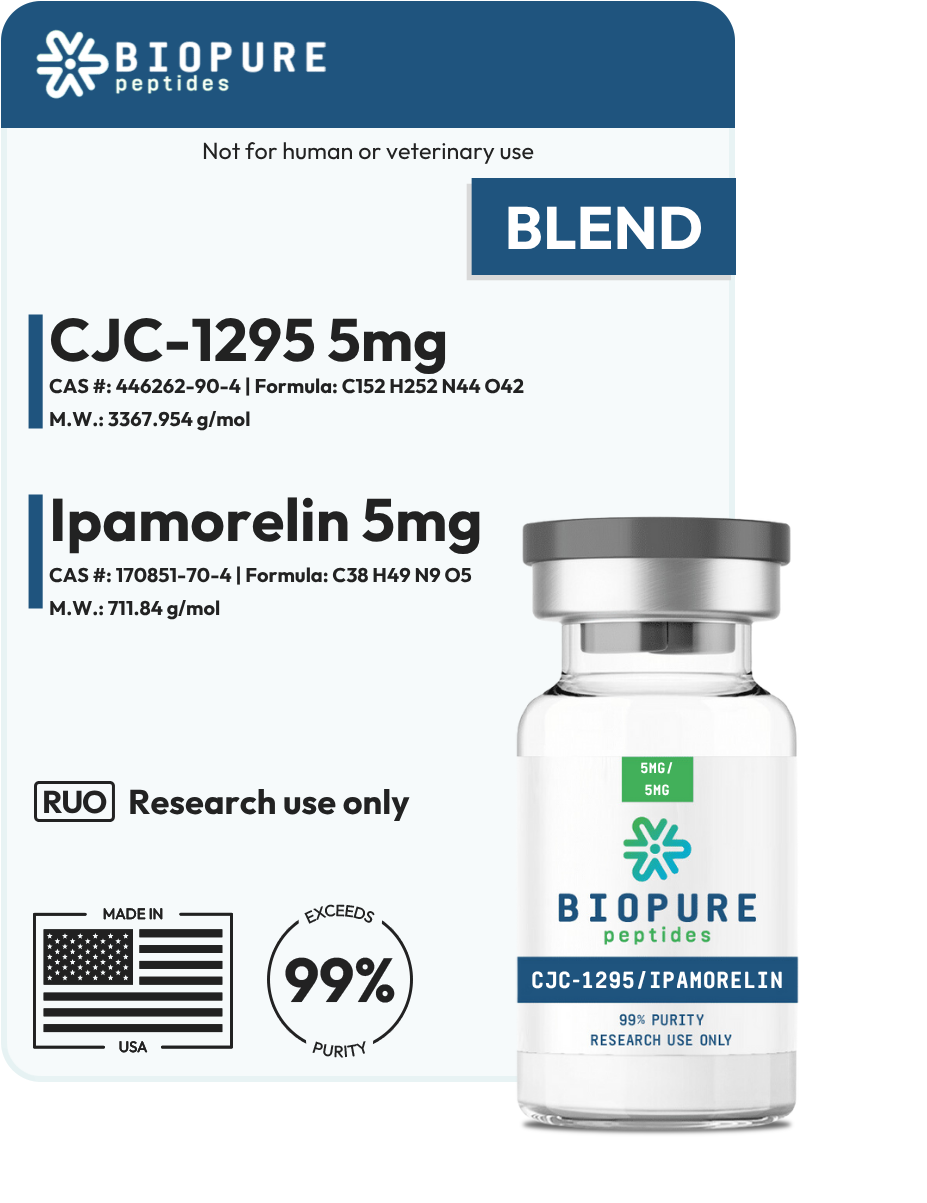
What is in the BioPure CJC-1295 / Ipamorelin vial?
The CJC-1295 / Ipamorelin 10mg product is a blend of the two peptides, supplied as a lyophilized (freeze-dried) powder in a sterile vial. The product page does not list a CAS number, molecular weight or the split between the two peptides, so we do not state them here. Our peptides are synthesized at a WHO/GMP and ISO 9001 certified laboratory in California. For more on the powder format, see Lyophilization Explained.
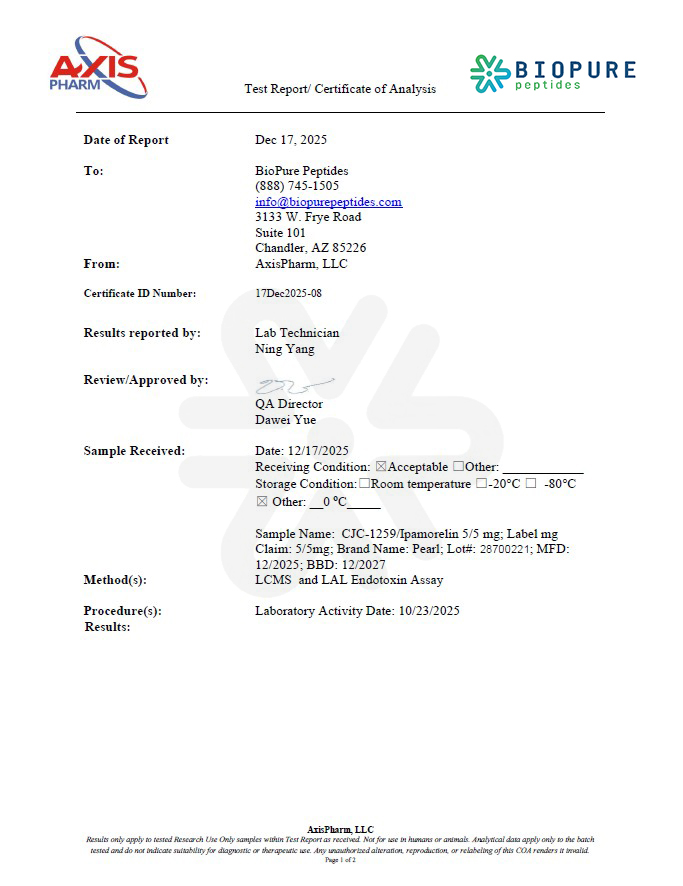
How is a CJC-1295 / Ipamorelin blend tested?
A blend needs more checking than a single peptide, because two compounds must each be confirmed.
- Identity by mass: each peptide should match its expected molecular mass. This is how a CJC-1295 without DAC would be told apart from a DAC version.
- Purity by HPLC: the chromatogram should show the expected peaks for both peptides, with no unexplained extras.
- Content per vial: the report should make clear how the vial total relates to each component.
Ipamorelin contains non-natural amino acids, which makes mass confirmation especially useful. The COA for your lot is shown below, and our line-by-line COA guide explains each section.
Frequently asked questions
Is Ipamorelin a natural peptide?
No. It is a synthetic five-amino-acid peptide designed to act on the ghrelin receptor. Ghrelin is the natural molecule for that receptor.
What does GHS-R1a mean?
It stands for growth hormone secretagogue receptor 1a, the formal name for the ghrelin receptor. Ipamorelin is studied as an agonist, meaning a compound that activates that receptor.
What does DAC mean in CJC-1295 DAC?
DAC stands for drug affinity complex, a chemical addition designed to bind albumin. It changes the molecule’s mass, so the versions are not interchangeable.
Is there a lot of research on this exact blend?
Much less than on each peptide alone. Most published work is cell and preclinical research on the individual components, and findings on the combination are early.
Why does the same pathway have two different receptors?
Growth hormone release is regulated by more than one signal. GHRH acts through its own receptor, while ghrelin acts through a separate one, and researchers study how the two interact.
Every lot we sell has a Certificate of Analysis you can read before you order. Questions before you buy? Our team is in Chandler, Arizona: (888) 745-1505 or our contact page.
View CJC-1295 / Ipamorelin | 10mgAll products sold by BioPure Peptides are intended strictly for in-vitro laboratory and research use only. They are not for human or animal consumption. These statements have not been evaluated by the U.S. Food and Drug Administration, and these products are not intended to diagnose, treat, cure, or prevent any disease.