
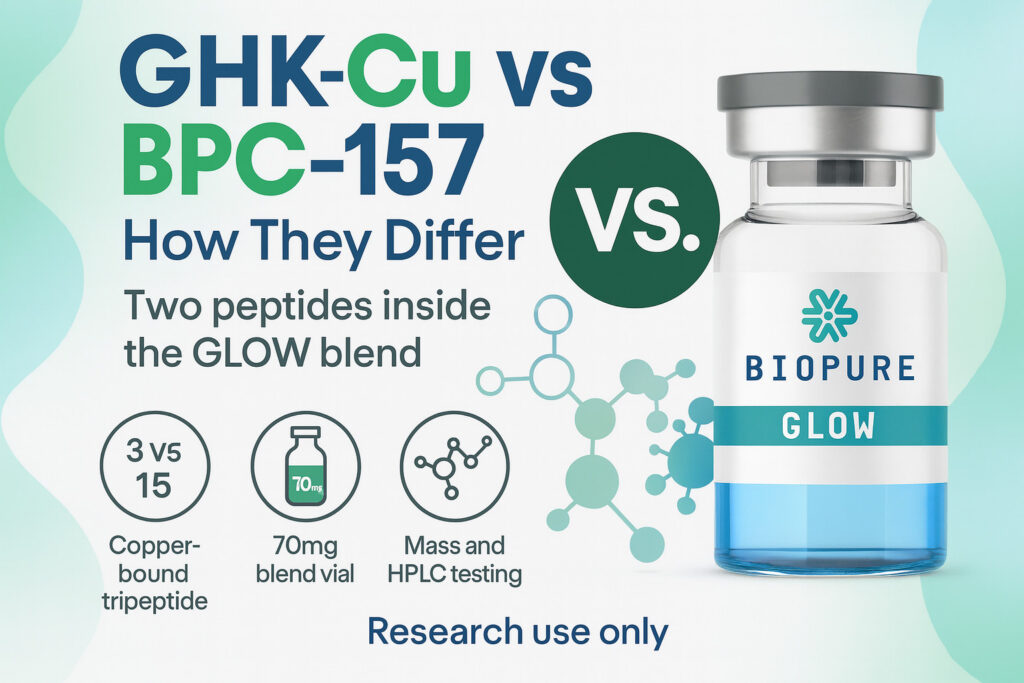
Quick answer: GHK-Cu and BPC-157 are very different molecules. GHK-Cu is a three-amino-acid peptide bound to copper, and BPC-157 is a 15-amino-acid peptide with no metal attached. Published laboratory research has examined them in different areas, and both appear in our GLOW blend alongside TB-500.
How do GHK-Cu and BPC-157 compare side by side?
GHK-Cu is also written as GHK-copper or copper tripeptide-1. BPC-157 is short for Body Protection Compound-157 and is also called a pentadecapeptide, meaning a chain of 15 amino acids. TB-500 is described as a synthetic fragment of thymosin beta-4, a much larger natural protein of 43 amino acids. The table sets out what each one is and what researchers have looked at.
| GHK-Cu | BPC-157 | TB-500 | |
|---|---|---|---|
| Structure | Tripeptide (glycyl-histidyl-lysine) complexed with copper | Linear chain of 15 amino acids | Synthetic fragment of thymosin beta-4 |
| Size | 3 amino acids, plus copper | 15 amino acids | Shorter than the 43-amino-acid parent protein |
| Amount in a GLOW vial | 50 mg | 10 mg | 10 mg |
| Proposed target | Copper-dependent signaling and extracellular matrix pathways | Angiogenesis-related and nitric oxide signaling, as proposed by researchers | Actin binding and cell movement |
| Research areas examined | Collagen production, skin structure, hair follicle signaling | Connective tissue, gut lining, inflammation models | Cell migration, tissue remodeling |
Which one has more published research?
Neither has a deep body of evidence, and what exists is mostly early.
GHK-Cu
GHK was first isolated from blood plasma. Cell studies and preclinical research have examined its effect on collagen and other structural proteins, and gene-expression studies have looked at the pathways it touches. Much of the work is in skin and hair follicle models. This is the longest-studied of the three in cell culture.
BPC-157
BPC-157 research is almost entirely preclinical. Studies report on tendon, gut and inflammation models, and researchers propose that growth-factor and nitric oxide pathways are involved. The mechanism is not settled, and the evidence comes from a fairly small number of research groups. We cover it further in our BPC-157 product listing.
Where does TB-500 fit in?
TB-500 is studied for a third thing: how cells move and how they organize their internal scaffolding, called actin. That makes it a different question from either of the other two. Sources also define TB-500 differently, as a short fragment or as something closer to the full protein. Our article on TB4 vs TB500 explains the difference. Whether combining the three adds anything beyond studying each alone is a separate question, which we examine in Peptide Blends vs Individual Stacks.
What is in a GLOW vial?
GLOW is a 70 mg lyophilized (freeze-dried) blend of GHK-Cu (50 mg), BPC-157 (10 mg) and TB-500 (10 mg). It is sold for laboratory research use only. You can see the full listing on the GLOW product page.
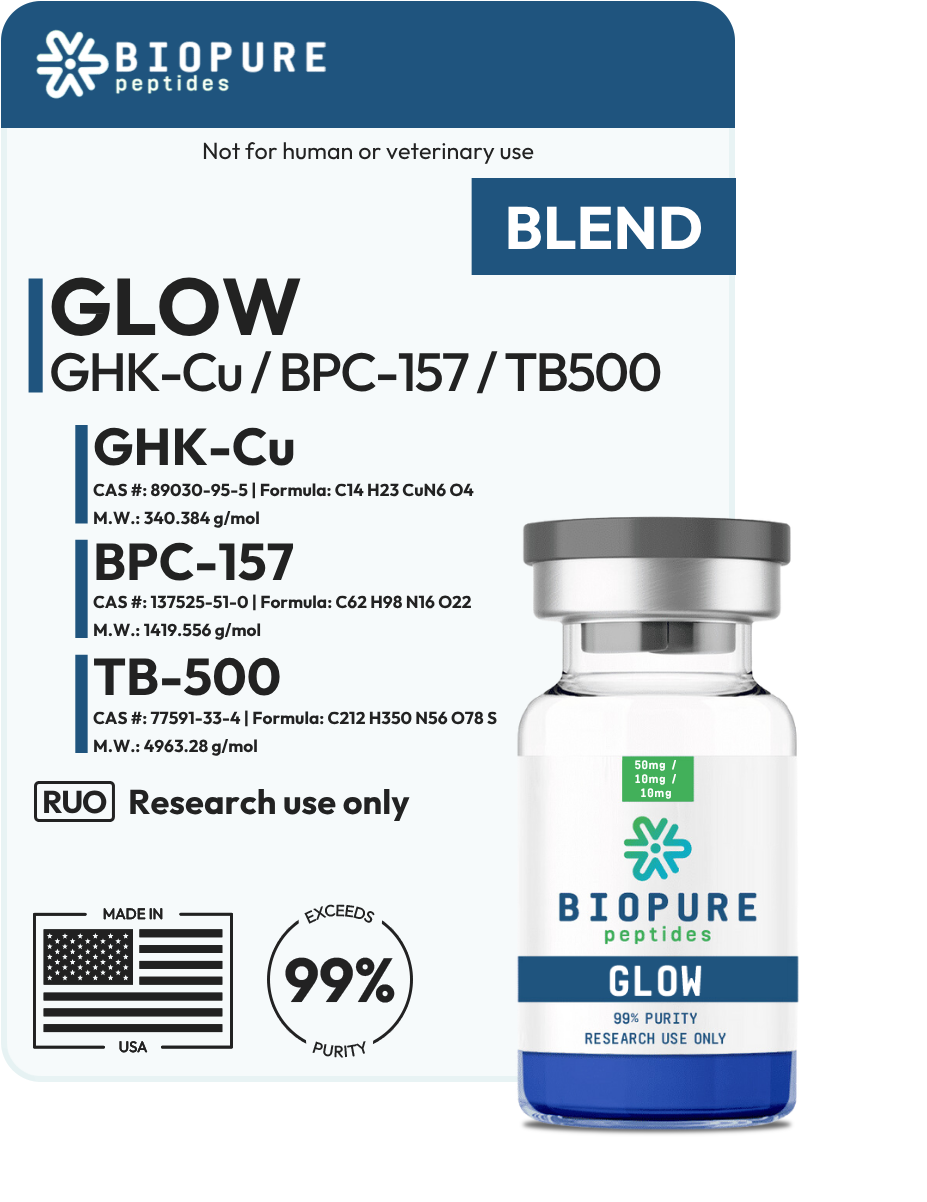
Because GHK-Cu makes up most of the vial by weight, a blend is not three equal parts. Our peptides are synthesized at a WHO/GMP and ISO 9001 certified laboratory in California.
How can you tell them apart on a COA?
A Certificate of Analysis (COA) for a blend should account for each peptide separately. Our line-by-line COA guide covers the basics. These are the points specific to these three:
View the Certificate of Analysis for GLOW - GHK-CU / BPC-157 / TB500 | 70mg (PDF)
- Identity by mass: BPC-157 should appear at a molecular weight near 1,419 g/mol. The GHK peptide alone is roughly 340 g/mol, and the copper complex reads higher because of the metal. TB-500 depends on which fragment is used, so the stated sequence matters.
- Purity by HPLC: a blend should show a separate peak for each component. One peak for a three-peptide blend is a warning sign.
- Content per vial: look for a figure for each peptide that matches the listed 50, 10 and 10 mg.
- Copper: GHK-Cu should be described as a copper complex. A pale blue tint in the powder is common for copper peptides, so a blend may not look pure white.
Frequently asked questions
Is GHK-Cu the same as a copper peptide?
Yes. "Copper peptide" is the common name for GHK-Cu, which is the GHK tripeptide bound to a copper ion.
Does GLOW contain copper?
Yes, because one of its three components is GHK-Cu. BPC-157 and TB-500 do not contain copper.
Is BPC-157 a protein or a peptide?
It is a peptide. With 15 amino acids, it is far shorter than a typical protein. Its sequence is based on a fragment of a protein found in gastric juice.
Why does a blend need a separate peak for each peptide on HPLC?
HPLC separates molecules by how they travel through a column. Different peptides travel at different speeds, so each should show up as its own peak.
Is GHK-Cu or BPC-157 the better peptide for research?
Neither is ranked higher. They are studied for different pathways, so the right one depends on the question a lab is asking. We also explain when we point researchers to a single compound in Why We Sometimes Choose GHK-Cu Over GLOW.
Every lot we sell has a Certificate of Analysis you can read before you order. Questions before you buy? Our team is in Chandler, Arizona: (888) 745-1505 or our contact page.
View GLOW - GHK-CU / BPC-157 / TB500 | 70mgAll products sold by BioPure Peptides are intended strictly for in-vitro laboratory and research use only. They are not for human or animal consumption. These statements have not been evaluated by the U.S. Food and Drug Administration, and these products are not intended to diagnose, treat, cure, or prevent any disease.