
How to Read a Peptide Certificate of Analysis: A Line-by-Line Guide
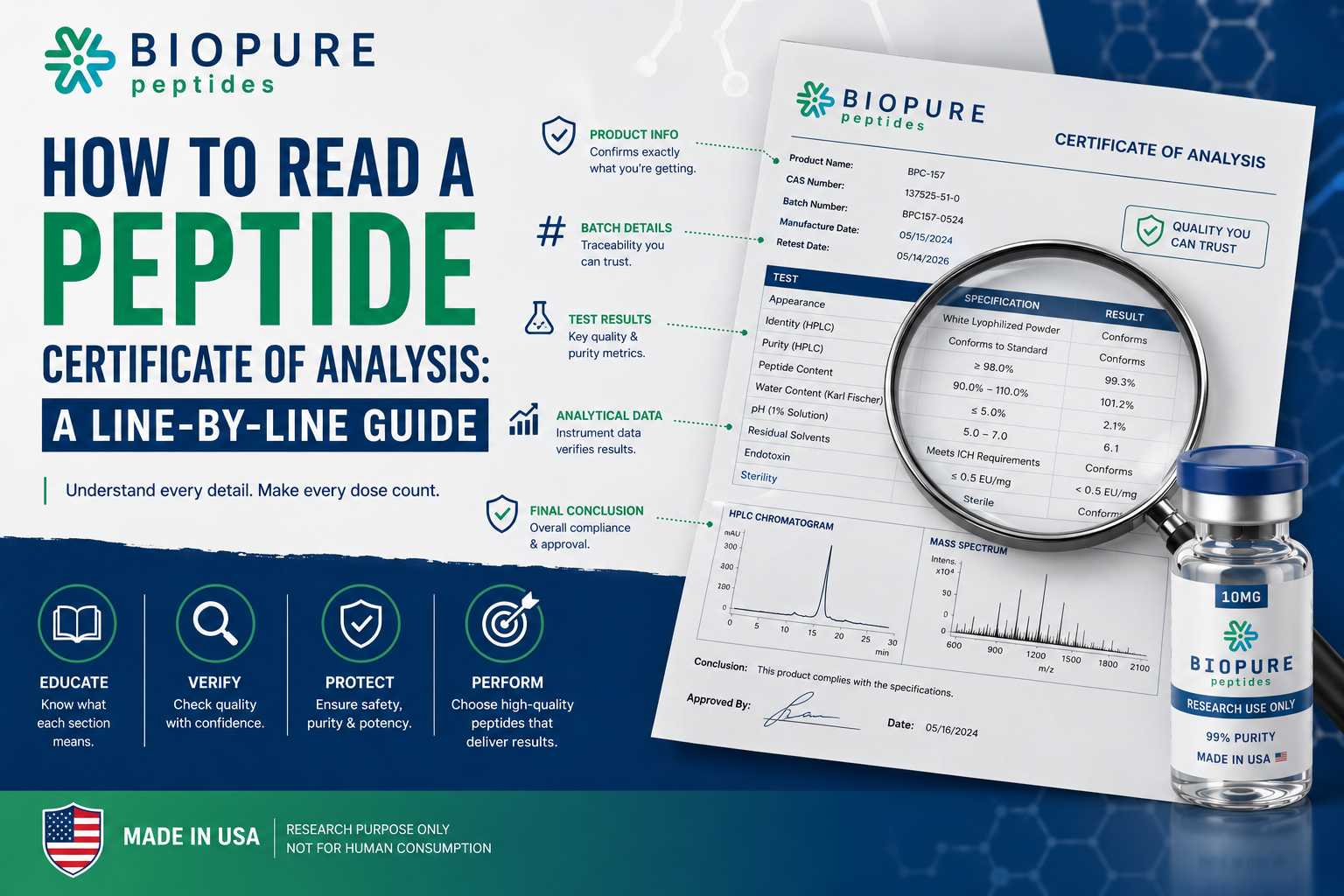
A Certificate of Analysis is the only document in this industry that can be checked.
Everything else — the homepage claims, the purity badge, the “third-party tested” line in a product description — is assertion. A COA is a record of what a laboratory measured, using named methods, on a specific batch of material. It’s the difference between a supplier telling you the product is good and a supplier showing you the data.
The trouble is that most COAs are written for people who already know how to read them. Fields are abbreviated, methods are cited by number, and the single figure most buyers look for — purity — turns out to be the one that requires the most context to interpret correctly.
This guide walks through a peptide COA from the top of the page to the bottom. We’ve written it to be useful regardless of who you buy from. If you’d rather work through it with a document in front of you, request a lot-specific COA from your current supplier and read along.
Part 1: The header block — identity and traceability
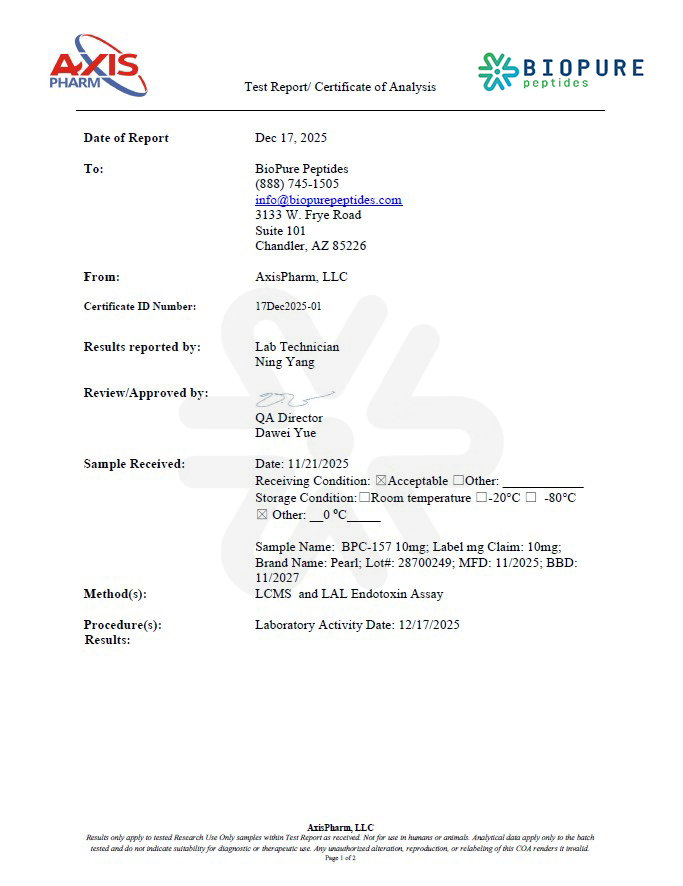
The top section of a COA establishes what was tested and which batch. Nothing below it means anything without it.
Product name and sequence
The peptide should be identified by its full name, and ideally by its amino acid sequence in one-letter or three-letter code. The sequence is the actual definition of the compound — trade names and nicknames are not.
This matters more than it sounds. Several peptides in common circulation are sold under names that don’t map cleanly to a single molecule, and closely related analogs differ by one or two residues. The sequence removes ambiguity.
CAS number, molecular formula, molecular weight
The molecular formula and molecular weight let you verify the mass spectrometry result later in the document, which is one of the few checks you can perform yourself with nothing but a calculator. Note whether the COA reports average mass or monoisotopic mass — for a peptide of moderate size these differ by roughly one dalton, and comparing the wrong pair will make a correct result look wrong.
Lot or batch number
This is the field that makes a COA a COA rather than a brochure.
The lot number on the document must match the lot number printed on the vial you received. A “representative” COA, a “sample” COA, or a COA with the lot field left blank tells you what the supplier’s product looked like at some unspecified point in the past. It says nothing about the material in front of you.
Dates: manufacture, analysis, retest
You want three dates, or at least two. Manufacturing date tells you the age of the material. Date of analysis tells you when the testing was performed — a COA analyzed two years ago describes a two-year-old snapshot. A retest or reevaluation date indicates the manufacturer has a defined stability position rather than an open-ended one.
Quantity and appearance
Fill weight per vial, and a physical description — typically a white to off-white lyophilized powder or cake. Appearance is a real analytical result, not decoration: discoloration, stickiness, or collapse of the lyophilized cake can indicate moisture ingress or degradation.
Storage conditions
Recommended storage for the lyophilized material, and often a separate condition once reconstituted. If a COA omits storage entirely, the manufacturer either hasn’t characterized stability or isn’t sharing it.
Part 2: The results table — what each test actually proves
This is the body of the document, usually a table with four columns: test, method, specification (the acceptance criteria), and result.
Pay attention to the specification column. A result of 98.7% means something different against a spec of ≥95.0% than against a spec of ≥99.0%. A results table with no specifications is a list of numbers, not a quality decision.
Identity by mass spectrometry
What it answers: Is this the right molecule?
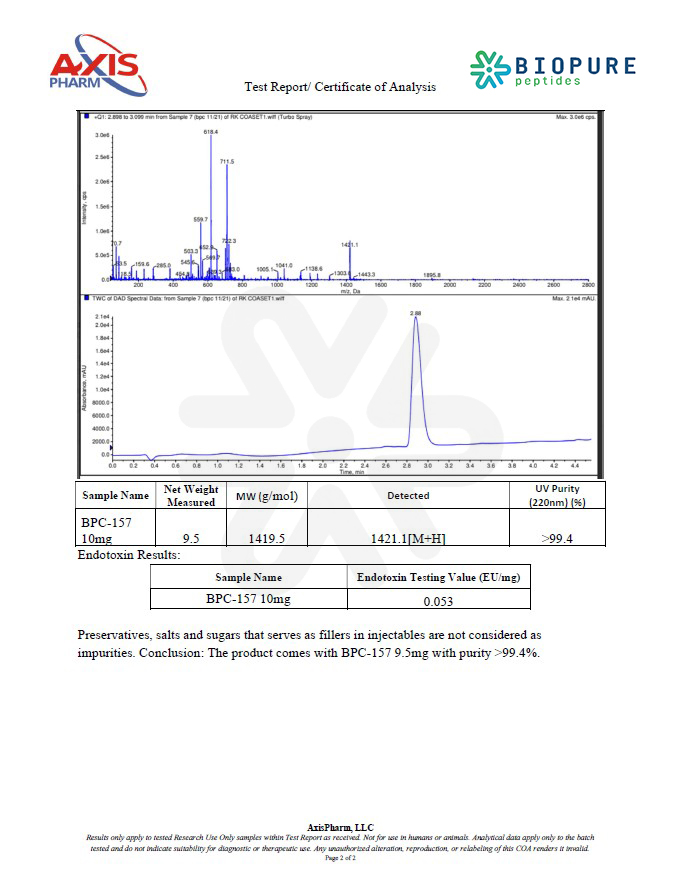
Typically ESI-MS or MALDI-TOF. The COA reports a theoretical mass and an observed or found mass, and the acceptance criterion is usually that the observed mass conforms to theory within a stated tolerance.
Two things worth noticing. First, electrospray produces multiply charged ions, so the raw instrument reading may be an m/z value like [M+2H]²⁺ rather than the molecular mass itself — a COA reporting a deconvoluted mass has done that arithmetic for you. Second, an observed mass that matches theory to four decimal places on a routine QC instrument is implausibly perfect. Real measurements have error. A number that looks typed rather than measured probably was.
What it does not prove: Purity. Mass spec confirms the target peptide is present. It does not tell you what else is in the vial.
Purity by RP-HPLC
What it answers: What fraction of the peptide material is the target sequence?
Reversed-phase HPLC separates components by hydrophobicity. The chromatogram shows peaks; purity is reported as the area of the main peak as a percentage of total integrated peak area.
A properly documented HPLC line specifies the column (commonly C18), the mobile phase (typically water and acetonitrile with 0.1% TFA), the gradient, the flow rate, and the detection wavelength. That wavelength is usually 214 or 220 nm, where the peptide bond itself absorbs — 280 nm detection only sees aromatic residues and will misrepresent peptides lacking tryptophan or tyrosine.
What it does not prove: How much peptide is in the vial by mass. See net peptide content below. This is the single most common misreading of a peptide COA, and the reason the next section exists.
Net peptide content
What it answers: What percentage of the total powder mass is actually peptide?
Determined by amino acid analysis, nitrogen analysis, or quantitative UV. The rest of the mass is water and counterion salt — real, weighable material that is not peptide.
For a peptide with several basic residues, net peptide content can sit well below the HPLC purity figure. Both numbers can be entirely accurate at the same time: HPLC purity describes the composition of the peptide fraction, net peptide content describes the proportion of the vial that is peptide fraction.
A COA that reports HPLC purity and omits net peptide content is not necessarily hiding anything — plenty of legitimate documents stop there. But if you’re comparing prices per milligram across suppliers, you are comparing powder, not peptide, until you have this number.
Water content
What it answers: How much residual moisture remains after lyophilization?
Measured by Karl Fischer titration. Beyond its contribution to mass, water is the practical driver of long-term stability in a lyophilized product — higher residual moisture generally means faster degradation in storage.
Counterion content
What it answers: How much salt came along from purification?
Peptides purified by RP-HPLC in TFA-containing mobile phase carry TFA as the counterion unless a salt exchange was performed. Measured by ion chromatography or ¹⁹F NMR. Some manufacturers exchange to acetate or hydrochloride, which should be stated.
Related substances and impurity profile
Higher-quality COAs list individual impurities rather than lumping everything into “other.” Common peptide impurities are structurally informative: deletion sequences from incomplete coupling, truncated chains, oxidation at methionine (+16 Da), deamidation at asparagine or glutamine (+1 Da), and dimers formed through disulfide bonds.
A supplier who characterizes impurities is running process control. A supplier who reports only a purity percentage may be running a single test on someone else’s material.
Endotoxin, bioburden, sterility
What it answers: Bacterial contamination, where relevant to the intended laboratory application.
Bacterial endotoxin is measured by LAL assay and reported in endotoxin units per milligram (EU/mg). Not every research-grade peptide is tested for it, and its absence from a COA isn’t automatically a defect — but for applications where endotoxin matters, its absence means you don’t have the data.
Residual solvents
Acetonitrile, methanol, DMF and others from synthesis and purification, typically by gas chromatography and evaluated against ICH residual solvent limits.
Part 3: The mass balance check
Here is a check almost nobody performs, and it takes thirty seconds.
The vial contains peptide, water, counterion, and trace residuals. Those should approximately account for the whole mass. Illustratively:
| Component | Result |
|---|---|
| Net peptide content | 82% |
| Water (Karl Fischer) | 5% |
| TFA counterion | 11% |
| Residual solvents / other | <2% |
| Total | ~100% |
With HPLC purity of, say, 99.2%, this document is internally consistent and tells a complete story: of the powder, 82% is peptide; of that peptide, 99.2% is the target sequence.
If the numbers on a COA can’t be made to reconcile — or if there aren’t enough of them to try — that’s worth a question. Documents assembled from marketing copy rather than laboratory records tend to fail this check, because the individual figures were never meant to relate to each other.
Part 4: Reading the chromatogram
If the COA includes the HPLC trace, spend a minute on it.
The main peak should be sharp and symmetrical. Significant tailing or fronting can indicate column or method problems that also affect the integration.
Retention time should be consistent across lots of the same product. A retention time that moves substantially between batches, with no method change noted, is worth asking about.
Shoulder peaks — small peaks partially merged with the main peak — usually represent closely related impurities such as deletion or oxidized sequences. They’re common and not inherently alarming, but they’re also the impurities most easily absorbed into the main peak by generous integration.
The baseline should be flat and quiet. A noisy baseline makes small impurity peaks disappear into it.
Axis labels and scale should be present and legible. A cropped, unlabeled chromatogram image is decorative rather than informative.
Part 5: The footer
The bottom of the document should carry the name and title of the person releasing the batch, a signature or controlled electronic equivalent, the date of release, and the issuing entity’s name and address.
An unsigned COA is a draft. A COA from an entity that isn’t named is an anonymous document.
Red flags: a quick checklist
- No lot number, or a lot number that doesn’t match the vial
- No date of analysis, or a date far older than the material
- Purity reported with no method — no column, no wavelength, no gradient
- A specification column that doesn’t exist, so no result can pass or fail
- Identical purity figures across every product a supplier sells
- An observed mass that matches theory perfectly, with no measurement error
- Chromatogram cropped, unlabeled, or missing while purity is still claimed
- Net peptide content and water content both absent, making mass balance impossible
- No signature, no issuing laboratory, no letterhead
- A COA the supplier will not provide for your specific lot — the most telling one on the list
How to ask for one
A short email is enough:
Please send the lot-specific Certificate of Analysis for the product and lot I received, including the HPLC chromatogram and the mass spectrometry data.
The response time and the completeness of what comes back will tell you a great deal. Suppliers who manufacture their own material generally have this on hand. Suppliers who resell imported peptide often have to request it upstream, if they can obtain it at all.
At BioPure Peptides, our products are manufactured in the United States in a WHO/GMP and ISO 9001 certified facility and tested to greater than 99% purity, and we provide lot documentation on request. If you’d like to work through a COA with someone, call (888) 745-1505 — and if you’re evaluating suppliers more broadly, our companion piece on the ten questions to ask any peptide supplier covers the ground around the document itself.
All products sold by BioPure Peptides are intended strictly for in-vitro laboratory and research use only. They are not for human or animal consumption. These statements have not been evaluated by the U.S. Food and Drug Administration, and these products are not intended to diagnose, treat, cure, or prevent any disease.