

Quick answer: A BioLean3 Reta certificate of analysis (COA) should confirm three separate things: identity by mass spectrometry, purity by HPLC, and the actual peptide content of the vial. Each test answers a different question, and none of them replaces the others. Check that the report matches the lot number and the vial size on your label.
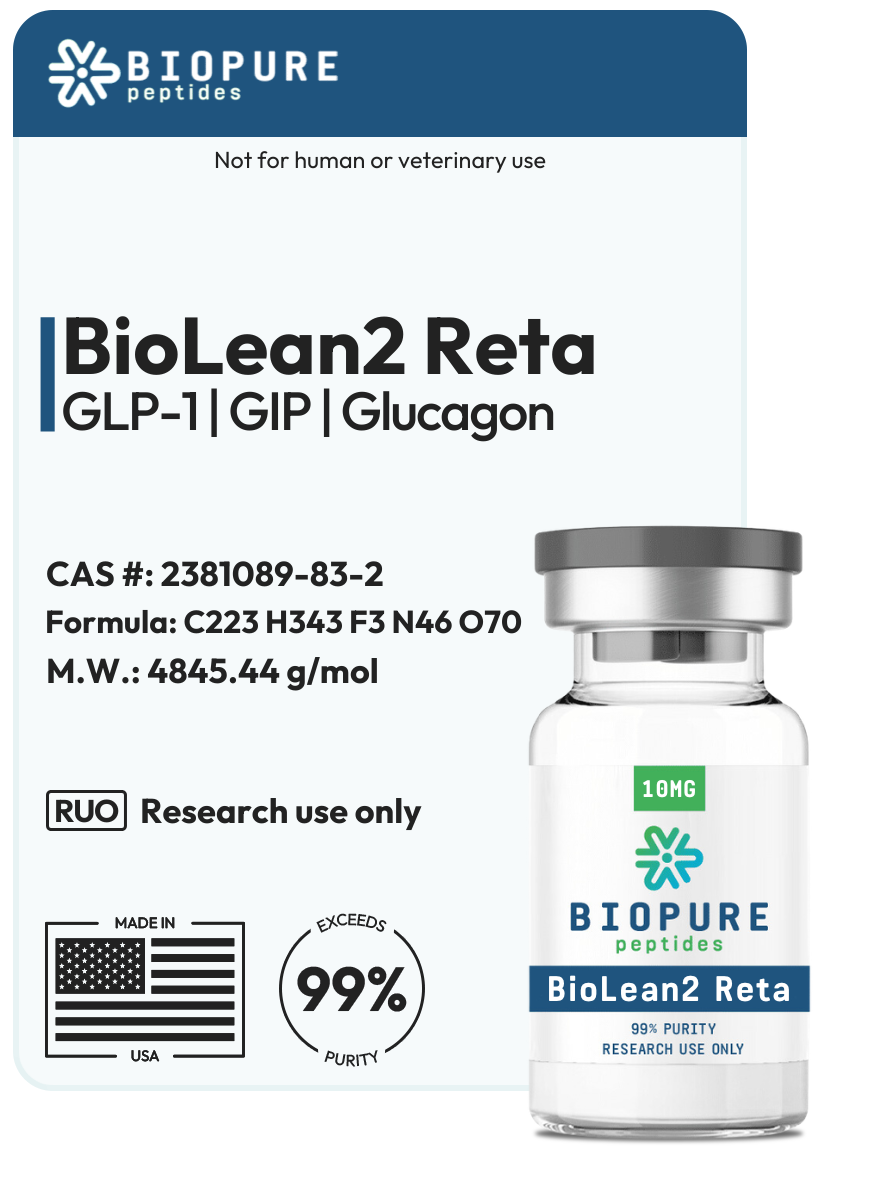
What is in the BioLean3 Reta 10mg vial?
BioLean3 Reta (also listed as BioLean3 Reta GGG, or simply Reta) is a triple-agonist research compound. Our product page associates it with GLP-1, GIP and glucagon receptor pathway models. It is supplied in a laboratory-grade vial with stability-preserving packaging and is sold for laboratory research use only.
This page covers the 10mg vial. The 30mg vial is a separate listing, BioLean3 Reta GGG 30mg, so confirm that the fill on your label and your COA agree with the listing you ordered. Our peptides are synthesized at a WHO/GMP and ISO 9001 certified laboratory in California.
How is the identity of BioLean3 Reta confirmed?
Identity is checked by mass spectrometry. The instrument weighs the molecules in the sample. The COA should list a theoretical mass calculated from the intended sequence and an observed mass from the instrument. The two should agree within a small instrument tolerance.
Peptides of this class are generally long chains. In the instrument they pick up several charges at once, so a raw spectrum shows a series of peaks. The report should show either that series or a calculated (deconvoluted) mass drawn from it. A COA that only says "identity confirmed" with no mass values gives you nothing to check.
What does HPLC purity show, and what does it miss?
HPLC (high-performance liquid chromatography) separates a sample into components and draws a peak for each. Purity is the main peak's share of the total peak area. For a full explanation of the format, see our line-by-line COA guide.
For a long peptide, the useful detail is in the small peaks near the main one. Synthesis errors tend to produce near-identical relatives: sequences with a missing residue or a modified one. These elute close to the target and can hide in a shoulder. Look for the chromatogram itself, not just the percentage, and for the detection wavelength and method named on the report. Our article on why synthesis determines peptide quality explains where these impurities come from.
Why is content per vial different from purity?
Purity describes the share of peptide-related material that is the right molecule. Content describes how much peptide is physically in the vial. A powder also carries water and counter-ions left from purification, so the net peptide weight can sit below the labeled fill even when purity is high.
A complete COA states how content was measured, for example by amino acid analysis or a quantitative HPLC method. If the report gives purity only, the content question is still open.
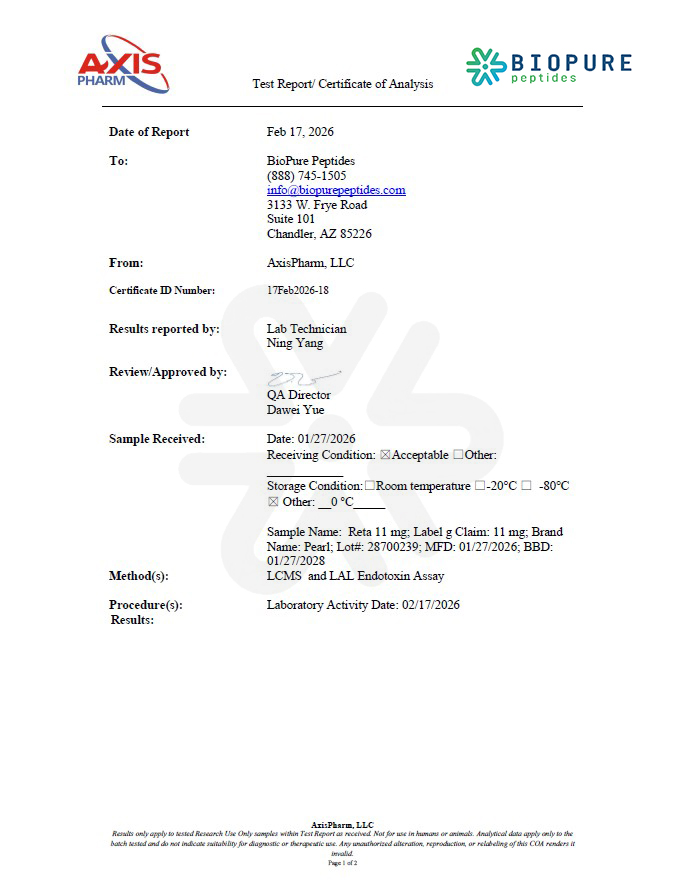
What should a BioLean3 Reta COA show?
| Line on the report | What to look for | What it cannot tell you |
|---|---|---|
| Lot or batch number | Matches the number on your vial | Whether other lots are the same |
| Mass spectrometry | Theoretical and observed mass, both listed | How much of the sample is the target |
| HPLC purity | Chromatogram, method and wavelength shown | Net peptide weight in the vial |
| Content per vial | Stated value and the method used | Purity of that content |
| Test date and lab | Recent date, named testing source | Condition of a vial after storage |
What quality problems are specific to a long multi-receptor peptide?
- Truncated and deletion sequences. Longer chains have more coupling steps, so more chances for a near-match impurity.
- Chemical drift in storage. Peptides can oxidize or change at certain residues over time, especially with moisture or heat exposure. This appears as new small peaks on a repeat HPLC run.
- Aggregation. Long peptides can clump. Standard HPLC may not flag it clearly.
- Fill mismatch. A purity figure alone says nothing about whether the vial holds the labeled amount.
Our product page describes internal quality verification and evaluation of compound integrity. Ask for the lot-specific COA for the exact vial you hold: BioLean3 Reta GGG 10mg.
Frequently asked questions
Why does the observed mass differ slightly from the theoretical mass?
Instruments have a small measurement tolerance, and molecules contain natural isotopes. A very small gap is normal. A large gap suggests a different molecule or a modification.
Can one lot's COA be used for another lot?
No. A COA describes the sample tested from one lot. Each lot needs its own report with a matching number.
Does HPLC prove the peptide is the right one?
No. HPLC shows how many components are present and in what proportion. Only the mass result addresses identity.
Does the COA include endotoxin or sterility results?
Only if those tests are listed on the report. If a line is absent, treat it as not reported rather than assumed.
Does a COA describe the vial after long storage?
No. It reflects the sample at the time of testing. Storage conditions afterward can change a peptide, which is why the test date matters.
Is the 10mg COA the same as the 30mg COA?
Not necessarily. The two vial sizes are separate listings, and each report should carry its own lot number and fill value.
Every lot we sell has a Certificate of Analysis you can read before you order. Questions before you buy? Our team is in Chandler, Arizona: (888) 745-1505 or our contact page.
View BioLean3 Reta GGG | 10mgAll products sold by BioPure Peptides are intended strictly for in-vitro laboratory and research use only. They are not for human or animal consumption. These statements have not been evaluated by the U.S. Food and Drug Administration, and these products are not intended to diagnose, treat, cure, or prevent any disease.