
Quick answer: NAD+ research is mostly about one job: NAD+ is a coenzyme that cells use to move energy and a substrate that several repair and signaling enzymes consume. Published work is strong on the basic biochemistry. It is much thinner and more disputed on what changing NAD+ levels means for whole organisms.
What is NAD+, and is it a peptide?
NAD+ is not a peptide. It is a dinucleotide, two nucleotides joined together, found in every living cell. Its full name is Nicotinamide Adenine Dinucleotide. You will also see NAD, NAD-plus, coenzyme I and DPN (diphosphopyridine nucleotide) in older papers.
It exists in two forms. NAD+ is the oxidized form and NADH is the reduced form. Cells convert between them constantly, which is why NAD+ is called a redox coenzyme.
What does NAD+ do in cells?
The first role is carrying electrons. In pathways such as glycolysis and oxidative phosphorylation (the process mitochondria use to make ATP), NAD+ accepts electrons and becomes NADH. This is among the best-established facts in biochemistry. It comes from decades of cell and enzyme work.
The second role is as a consumed ingredient. Some enzymes break NAD+ apart as part of their reaction. That makes NAD+ availability a possible control point for those enzymes. This second role drives most of the current interest.
Which enzymes use NAD+ up?
| Enzyme family | What it does with NAD+ | Research area |
|---|---|---|
| Sirtuins | Use NAD+ to remove chemical tags from proteins | Gene regulation, metabolic signaling, aging biology |
| PARPs | Use NAD+ to build chains on proteins at DNA damage sites | DNA repair, oxidative stress response |
| CD38 and related enzymes | Break NAD+ down to make calcium-signaling molecules | Calcium signaling, immune cell function |
Because all three draw on the same pool, researchers ask whether heavy use by one family can leave less for another. This is a hypothesis with supporting cell and preclinical data, not a settled model.
How do cells make NAD+?
Cells build NAD+ in three main ways. A de novo route starts from the amino acid tryptophan. Other routes recycle nicotinic acid or nicotinamide, the latter through a salvage pathway that most tissues rely on heavily.
Much of the aging-related work asks how these routes are regulated, and whether tissue NAD+ falls over time. Preclinical studies have reported lower NAD+ in some aged tissues. Interpretation varies between labs and tissues, so treat it as an active question.
How strong is the evidence?
- Strong: NAD+/NADH redox chemistry and the enzyme reactions above. These are well characterized in purified-enzyme and cell work.
- Moderate and growing: links between NAD+ availability and sirtuin, PARP and CD38 activity in cell cultures and preclinical models.
- Early or contested: broader claims about cellular resilience and aging. Results differ by model, tissue and method.
What is still unknown?
A central open question is how NAD+ supplied outside a cell is handled. Studies have reported that extracellular NAD+ can be broken down by surface enzymes into smaller pieces. Researchers debate whether, and by which transporters, the intact molecule or its fragments enter cells. NAD+ also acts as a signal outside cells, which complicates interpretation.
Measurement is another problem. NAD+ and NADH are unstable and easy to alter during sample handling, so numbers from different labs can be hard to compare.
The NAD+ 1000mg product and how it is tested
Our NAD+ 1000mg vial holds Nicotinamide Adenine Dinucleotide as a lyophilized (freeze-dried) powder, sold for laboratory research use only. For background on that form, see our lyophilization guide.
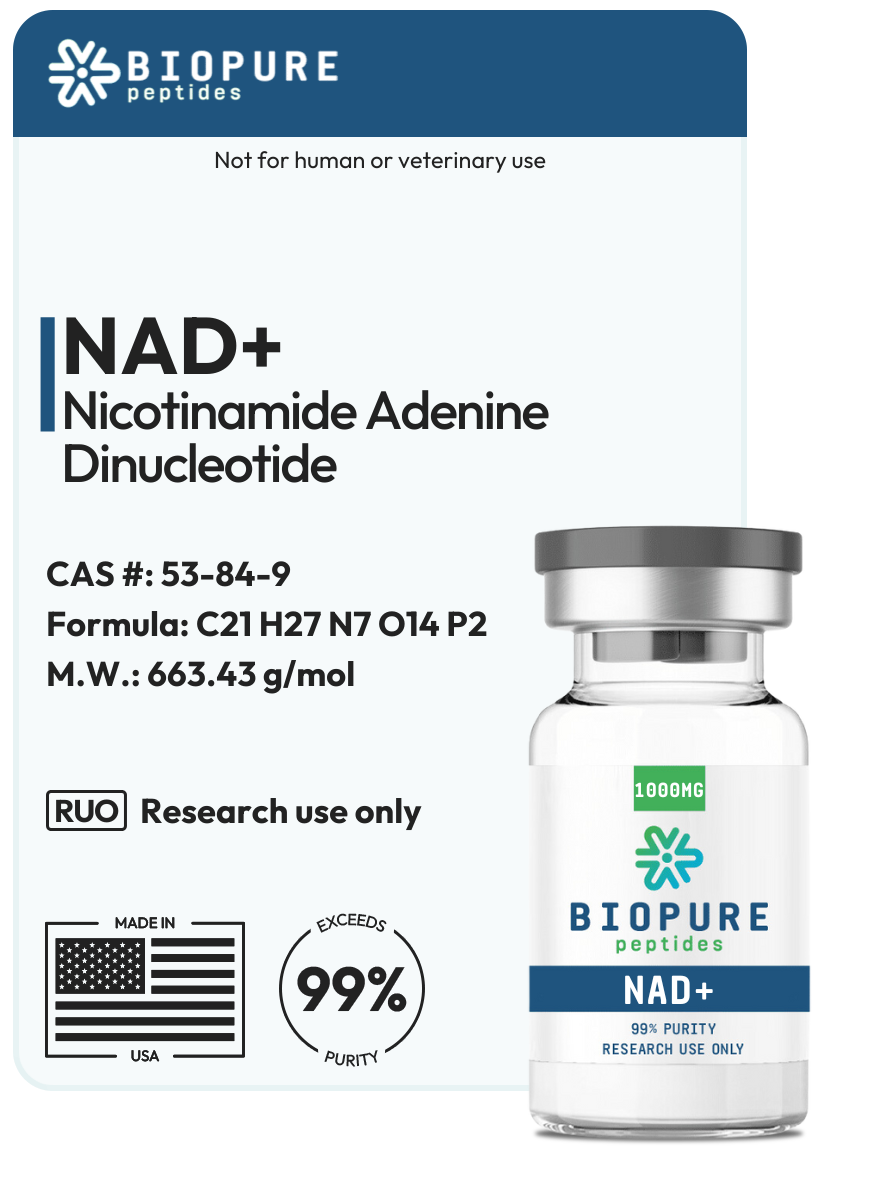
A few things matter for this compound in particular:
- Identity: confirmed by mass, since NAD+ and its reduced form NADH differ slightly.
- Purity: by HPLC. Look for how related substances such as nicotinamide, which can form as NAD+ breaks down, are handled.
- Content per vial: at this size, water content and salt form can shift the real amount of active compound, so check what the report states.
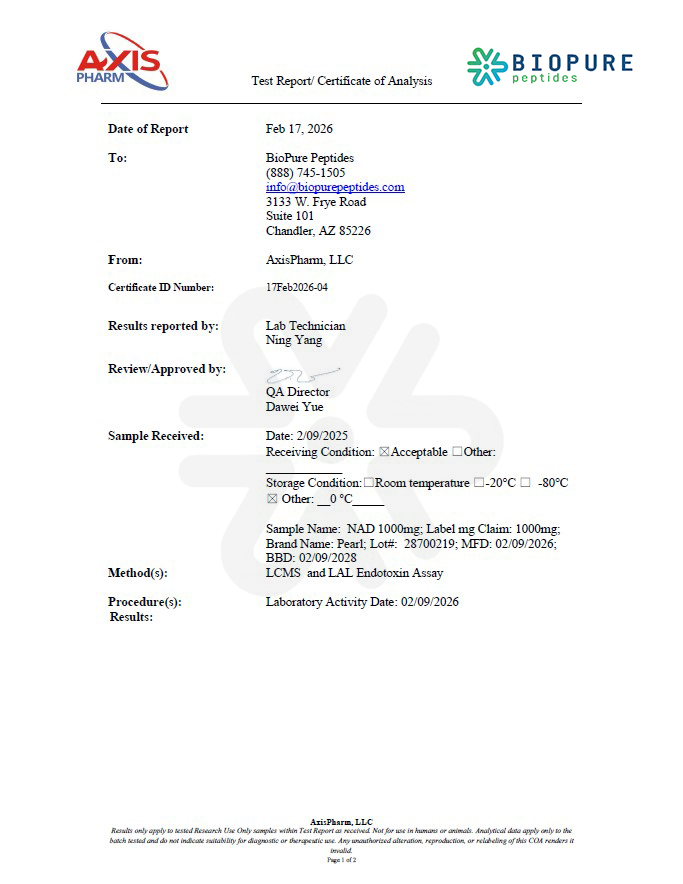
Our line-by-line COA guide explains each section of the report.
Frequently asked questions
Is NAD+ the same as NADH?
No. They are the oxidized and reduced forms of the same coenzyme. Cells convert between them as part of energy metabolism.
Why is NAD+ linked to mitochondria?
Mitochondria run the electron-transfer reactions that depend on the NAD+/NADH pair. For another mitochondria-focused compound, see our SS-31 overview.
What is the CAS number or alternate name for NAD+?
Common alternate names are NAD, NAD-plus, coenzyme I and DPN. Check the product page and COA for the identifiers tied to your lot.
Why can NAD+ be hard to measure?
The molecule breaks down quickly and the NAD+/NADH balance shifts during sample preparation. Different extraction methods can give different results.
Does a bigger vial mean a purer product?
No. Vial size tells you the amount of material, not its quality. Purity and identity come from the testing report.
Every lot we sell has a Certificate of Analysis you can read before you order. Questions before you buy? Our team is in Chandler, Arizona: (888) 745-1505 or our contact page.
View NAD+ | 1000mgAll products sold by BioPure Peptides are intended strictly for in-vitro laboratory and research use only. They are not for human or animal consumption. These statements have not been evaluated by the U.S. Food and Drug Administration, and these products are not intended to diagnose, treat, cure, or prevent any disease.