
Why Peptide Dosing Information Online Contradicts Itself
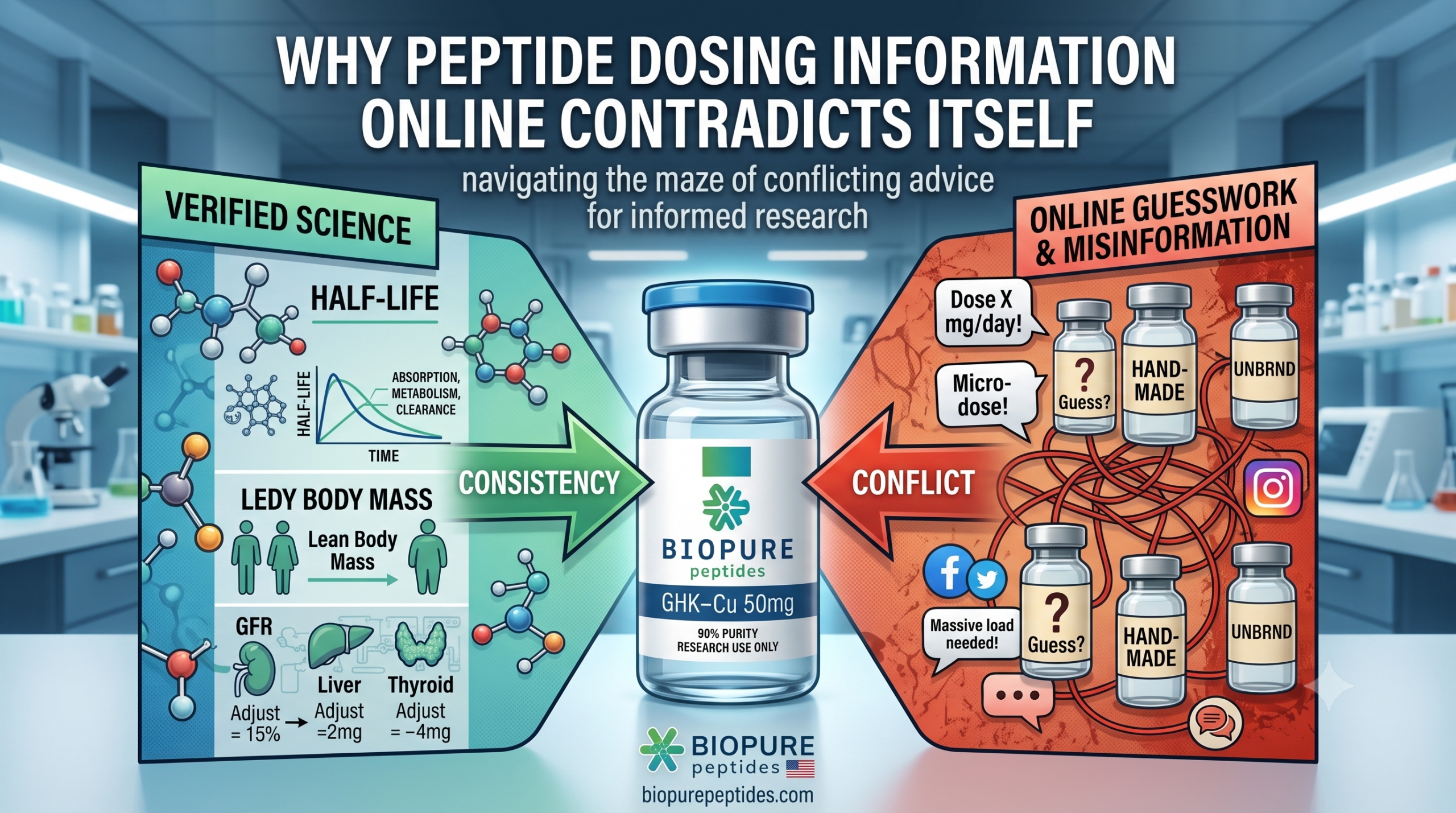
Search any research peptide and you'll find numbers. Search a little longer and you'll find different numbers. Keep going and you'll find a third set that contradicts both, stated with exactly the same confidence.
None of the sources will show their work. Most won't cite anything at all. The few that do will cite each other.
This is the single most common frustration people bring to us, and it deserves a real answer rather than a shrug. The contradictions aren't random, and they aren't mostly a matter of some sources being careless. They come from a small number of specific, identifiable failures - and once you can name them, the landscape becomes much easier to read.
We should say up front where we stand, because it shapes what this article does and doesn't contain. BioPure Peptides supplies compounds for laboratory research use only. They are not approved for human or animal use, and we don't publish human protocols. This article contains no dosing figures of any kind. What it offers instead is a way to evaluate the figures you encounter elsewhere.
The root problem: five kinds of information, read as one
Most of the contradiction resolves the moment you notice that the sources you're comparing aren't the same kind of source. They sit at wildly different levels of evidentiary strength, and they're routinely blended together into a single paragraph as if they were interchangeable.
From weakest to strongest:
Anecdote and forum lore. Individual reports, uncontrolled, with no independent verification of what was actually in the vial, no measurement of anything, and heavy selection bias in who bothers to post. The material's identity and purity are assumed rather than established. This is the largest volume of content in the space by a wide margin.
Vendor marketing copy. Written to sell. Often copied verbatim between sites. Frequently uncited, and when cited, cited circularly - vendor A references vendor B, who references a forum thread that originally paraphrased vendor A.
Aggregated and machine-generated articles. A rapidly growing category: content assembled from the two categories above, rewritten into authoritative-sounding prose, sometimes with citations that don't support the claim attached to them and occasionally with citations to papers that do not exist. Fluency is not evidence, and these read very fluently.
Animal studies. Real experimental data, properly conducted and peer reviewed. But findings are specific to the species, the model, the route of administration, and the formulation used. A figure from a rodent study is a fact about rodents.
In vitro studies. Rigorous, and the furthest removed from a whole organism. Concentrations in a cell culture dish describe the conditions in that dish. They do not translate into an amount of anything, in anyone.
Clinical trials of approved drugs. The strongest evidence available - and frequently about a different molecule than the research compound being discussed. Approved analogs, structurally related compounds, and the research peptides named after them are not the same substance, and the trial's formulation, population, and endpoints came as a package with its numbers.
When a search result blends a rodent study, a clinical trial of a related approved drug, and three forum posts into one confident paragraph, the output isn't a consensus. It's a collision.
Six specific failure modes
Beyond the mixing of evidence classes, a handful of concrete errors generate most of the direct contradictions.
1. Unit confusion
Milligrams, micrograms, and international units are not interchangeable, and they're confused constantly. A thousandfold difference separates the first two. The third isn't a unit of mass at all - it measures biological activity, and its conversion to mass differs by substance, so an IU figure cannot be converted without knowing the specific compound and standard it refers to.
A single transcription slip between these propagates silently through every site that copies it. Two sources that appear to disagree wildly are sometimes reporting the same figure in different units, and sometimes reporting a typo.
2. Molecule confusion
Research peptides carry nicknames, abbreviations, and marketing names that don't map cleanly onto single molecules. Closely related compounds differ by a residue or two. Analogs share a name with their parent sequence. Some widely used names in circulation refer to different things depending on who's writing.
We've written about two specific cases of this - TB4 versus TB500 and the "BPC Wolverine" naming convention - precisely because figures attached to one compound migrate to the other and are then reported as contradictory findings about a single substance.
The defense is simple: check the amino acid sequence, not the name.
3. Mass without net peptide content
Two vials with the same stated mass can contain measurably different amounts of peptide, because a lyophilized powder also contains counterion salt and residual water. A figure expressed in milligrams of powder isn't the same as a figure expressed in milligrams of peptide, and almost nothing online distinguishes them.
This is one of the less obvious sources of genuine disagreement between otherwise careful sources. Our COA guide covers the distinction in detail.
4. Route and formulation stripped away
A figure from a study is inseparable from how the compound was administered and what it was dissolved in. Numbers get lifted out of papers and repeated with that context removed, at which point they're no longer describing the experiment they came from.
5. Citation laundering
A figure appears once, without a source. It gets copied. The copy gets cited by a third site, which is then cited by a fourth. Within a year the number appears on a dozen pages and looks corroborated.
It isn't. It's one unsourced claim repeated a dozen times, and repetition is not replication. When you find the same specific figure phrased almost identically across several sites, that similarity is evidence of copying, not agreement.
6. No dates, no versions
Peptide literature moves. Undated articles are common, and an undated page presenting a figure as current may be summarizing a paper that has since been superseded, or reporting on a compound whose characterization has changed.
How to evaluate a claim you find
You don't need a chemistry background to apply most of this. Work down the list, and stop when a source fails.
Does it cite a primary source you can actually open? Not "studies show." A specific paper, with authors and a journal. If the citation exists, open it - a surprising proportion don't say what they're cited as saying.
Is it the same molecule? Check the sequence. Names are unreliable.
What species and what system? A cell culture result, a rodent result, and a human trial result are three different kinds of statement.
What route and formulation? If the source doesn't say, it has dropped context that the number depends on.
Are the units stated and internally consistent? Check whether the article uses the same units throughout, and whether the arithmetic in it actually works.
Is the source selling the compound? Not disqualifying - we sell peptides and we write about them - but it's a reason to require citations rather than accept assertions.
Does it distinguish what was measured from what was inferred? Careful writing marks the difference. Marketing copy blurs it.
Is it dated, and is the date recent enough to matter?
Does it acknowledge uncertainty anywhere? Real research is full of qualifications. A source with no hedging anywhere is not being more confident than the others - it's being less honest about the state of the evidence.
Where the reliable information actually lives
None of the above says that good information doesn't exist. It says it isn't usually what a search returns first.
Primary literature is indexed on PubMed and PubMed Central, both free and searchable by compound name or sequence. ClinicalTrials.gov lists registered trials with their protocols and, often, their results - including trials that failed, which are exactly the ones that don't get summarized on content sites. Publisher sites carry the full papers, and many are open access.
Reading a primary paper is slower than reading a summary and considerably more informative, because you can see what was measured, in what, and how large the effect was relative to the noise.
Why we don't publish protocols
We get asked, and the answer is consistent.
The products we sell are supplied for laboratory research use only. They are not approved by the FDA for human or veterinary use, and they are not intended to diagnose, treat, cure, or prevent anything. A supplier that publishes human administration protocols alongside those products is describing an intended use its products aren't approved for - and misrepresenting what it's selling in the process.
There's a second reason, less legal and more practical. A supplier is the worst possible source for that information. We have a commercial interest in the answer, and no ability to verify the conditions anyone is working under. Even if publishing it were appropriate, we would not be a good source.
What we can help with is everything on our side of the vial: what the compound is, how it was synthesized, what the analytical data shows, what the documentation covers, how the material should be stored, and how to tell a well-run supply chain from a poorly-run one. Those are answerable questions, and we can answer them with data rather than assertion.
If you have one, call (888) 745-1505 or use our contact page.
All products sold by BioPure Peptides are intended strictly for in-vitro laboratory and research use only. They are not for human or animal consumption. These statements have not been evaluated by the U.S. Food and Drug Administration, and these products are not intended to diagnose, treat, cure, or prevent any disease.