
Why the Same Peptide Comes in 2mg, 5mg, and 10mg Vials
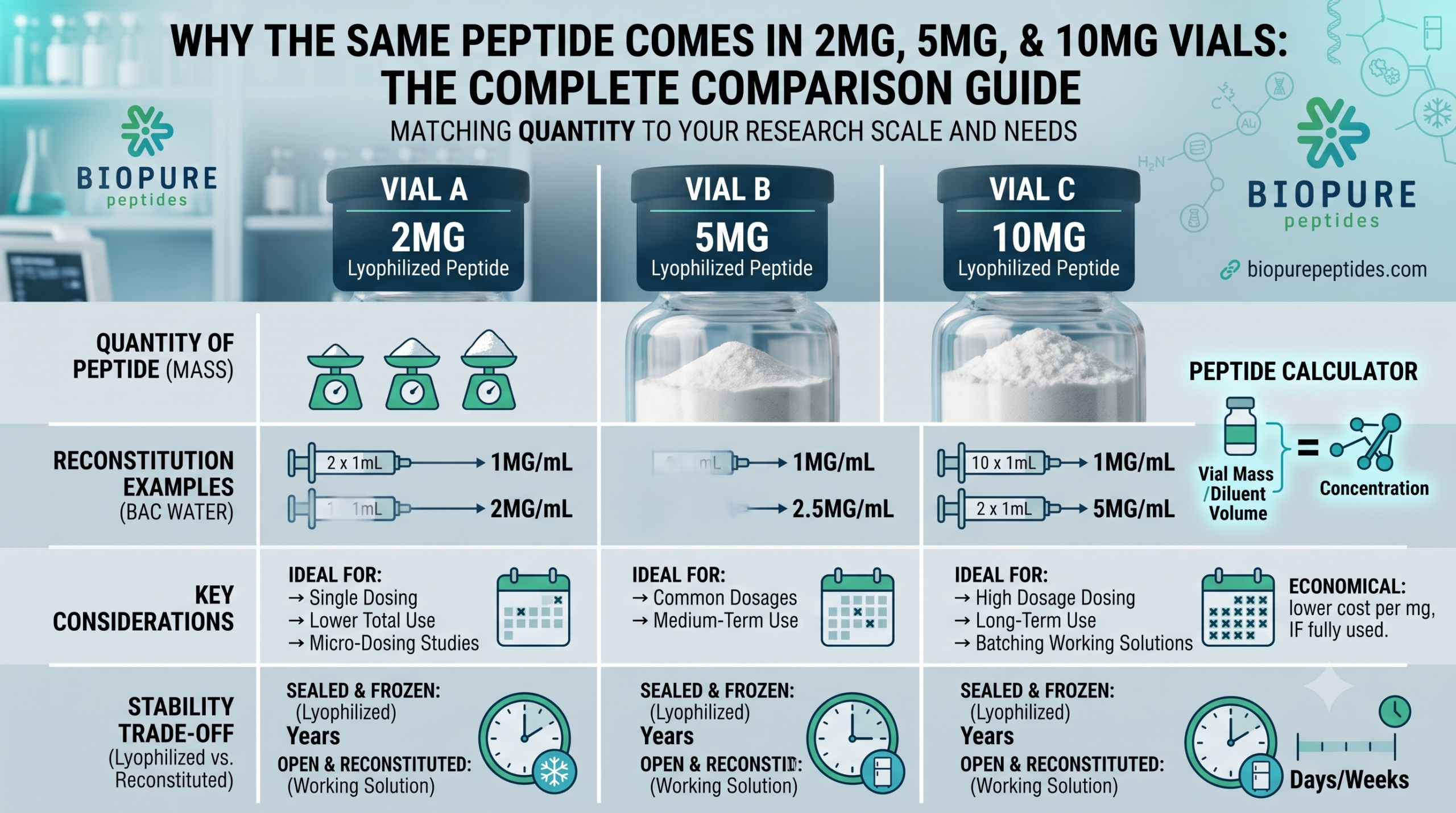
Look at almost any research peptide catalog and you'll find the same compound offered at two or three different fill weights. Same sequence, same purity specification, same manufacturer - but 2mg, 5mg, and 10mg options sitting side by side at prices that don't scale the way you'd expect.
The obvious assumption is that this is a pricing strategy. Buy more, pay less per milligram, same as anything else.
That's part of it, but it's the smaller part. Fill weight is constrained by the physics of freeze-drying, by a cost structure that is mostly fixed regardless of how much peptide goes in the vial, and by a stability tradeoff that cuts in both directions. Understanding what's actually driving those numbers makes it much easier to tell a considered product line from an arbitrary one - and to work out which option is genuinely the better value.
First: the vial itself is usually identical
A common misconception is that a 10mg vial is a bigger vial. Typically it isn't.
Research peptides are usually filled into standard 2mL or 3mL glass vials with the same stopper and the same crimp seal, regardless of whether they hold 2mg or 10mg of material. Ten milligrams of lyophilized peptide is a very small amount of solid - a thin disc at the bottom of a vial that is, by volume, mostly empty space.
This is why fill weight can't be judged by eye, and why "the vial looks half empty" is not a meaningful observation about either option. What differs between the products is the mass of peptide dispensed before freeze-drying, not the container.
Constraint one: lyophilization sets the boundaries
Freeze-drying is not indifferent to how much material is in the vial. It imposes real limits at both ends.
At the low end: there may not be enough solid to form a cake
A lyophilized cake needs enough dissolved solid to build a structure. Below a certain mass, freeze-drying a peptide solution leaves a thin film, a barely visible residue, or a few flakes clinging to the glass rather than a coherent cake.
That's not necessarily a quality failure - the peptide is present and correct - but it makes visual inspection useless, increases the proportion lost to the vial walls during handling, and makes the product look, to the buyer, like nothing arrived.
Manufacturers address this in one of two ways. They set a practical minimum fill weight, which is a large part of why 1mg and sub-milligram vials are less common than 2mg. Or they add a bulking agent - an excipient such as mannitol that provides the structure the peptide alone can't. Either is legitimate. What matters is that excipients, if present, appear on the documentation.
At the high end: drying gets harder
More material generally means either a larger fill volume or a more concentrated solution, and both complicate the cycle.
A deeper fill increases the distance water vapor has to travel to escape, which lengthens primary drying. A longer cycle at the wrong shelf temperature raises the risk of exceeding the collapse temperature in the lower layers of the cake - the defect that produces a dense, glassy mass instead of a porous one and traps moisture inside.
Higher concentration brings its own issues. Some sequences aggregate more readily when concentrated, and as ice forms, the remaining solution becomes dramatically more concentrated still, which can shift pH as buffer components crystallize at different rates.
The practical consequence: each fill weight is effectively its own validated process. A cycle developed for a 2mg fill doesn't automatically transfer to 10mg. That's real development work, and it's a genuine reason a manufacturer might offer three fill weights rather than seven.
Constraint two: most of the cost isn't the peptide
This is the part that explains the pricing, and it surprises most people.
For a low-fill vial, the peptide is often a minority of the production cost. The fixed costs per vial are the same whether it holds 2mg or 10mg:
- The vial, stopper, aluminum seal, and label
- Cleaning, depyrogenation, and sterilization of components
- Fill-finish labor and line time
- Lyophilizer shelf space - a vial occupies the same footprint on the shelf regardless of what's inside it, and a freeze-drying cycle runs for many hours
- Inspection, labeling, and packaging
- Per-lot QC testing - HPLC, mass spec, Karl Fischer, and the rest cost the same whether the lot is 2mg vials or 10mg vials
- Documentation and batch record review
Drying a tray of 2mg vials consumes nearly the same energy, time, and capacity as drying a tray of 10mg vials. Testing them costs the same. Only the material differs.
Which is why a 10mg vial is almost never five times the price of a 2mg vial. The fixed costs are spread across more milligrams, so cost per milligram falls as fill weight rises - not because of a volume discount, but because the arithmetic of production says so.
It's also why the price gap between fill weights tells you something. A catalog where 10mg costs almost exactly five times 2mg is priced by marketing rather than by cost. A catalog where the per-milligram cost drops sharply with fill weight is behaving the way production economics actually work.
Constraint three: the stability tradeoff runs both ways
Larger fill weights are cheaper per milligram. They are not automatically the better choice.
A sealed, lyophilized vial is stable for a long time under proper storage. Once that seal is broken and the contents go into solution, a different and much shorter stability clock starts - hydrolysis, deamidation, oxidation, and aggregation all proceed in solution in ways they effectively don't in the dry state.
That creates a straightforward tension:
A larger vial means fewer seals broken, less packaging, less handling, and a lower cost per milligram - but it commits the entire contents to the solution stability window at once, and any material not used within it is compromised regardless of what it cost.
A smaller vial costs more per milligram but keeps the remainder sealed and dry, which is the state peptides tolerate best.
Aliquoting is the third path: reconstitute a larger vial and immediately divide it into single-use portions under appropriate conditions, so the bulk is stored frozen rather than repeatedly accessed. This preserves much of the cost advantage, but it introduces handling steps and freeze-thaw considerations of its own, and it's only as good as the technique behind it.
The right choice depends on the scale of the work, not on the headline price. Buying the largest available fill weight and discarding most of it is more expensive than buying the smallest.
Constraint four: some sequences won't tolerate high fills
Not every peptide is offered at every fill weight, and that's usually informative rather than arbitrary.
Sequences prone to aggregation, or with poor solubility in the fill solution, may not survive the concentration step required for a high fill. Others degrade measurably during the longer drying cycle a deep fill demands. When a manufacturer offers a compound only at lower fill weights, the most likely explanation is that higher fills didn't produce an acceptable cake or an acceptable stability profile.
Conversely, a supplier offering every compound in the catalog at every fill weight, with no exceptions, is worth a question. Uniformity like that is easier to achieve in a spreadsheet than in a lyophilizer.
What about overfill?
Manufacturers sometimes dispense slightly above the nominal fill weight to account for material lost to the vial and stopper during handling. This is standard pharmaceutical practice and entirely legitimate.
What matters is that it's documented rather than used as a marketing claim. "Generously overfilled" on a product page, with no fill weight verification on the COA, is a claim you cannot check. A stated nominal fill weight with a documented tolerance is one you can.
How to compare fill weights properly
Three steps, in order.
1. Convert to cost per milligram of peptide, not per milligram of powder. This is where net peptide content matters. A 10mg vial at 78% net peptide content contains meaningfully less actual peptide than a 10mg vial at 88%, and the cheaper one on the shelf may be the more expensive one in practice.
2. Check that the fill weight appears on the label and the documentation. It should be stated, not implied by the product name.
3. Match the fill weight to the scale of the work. Specifically, to how much material will be used within the period a reconstituted solution remains within specification - not to what looks cheapest per milligram on the catalog page.
The short version
Fill weight options exist because lyophilization has a floor and a ceiling, because production costs are mostly fixed per vial rather than per milligram, and because the cost advantage of a larger vial is partly offset by the stability cost of committing more material to solution at once.
None of that is visible from a product page. It is, however, visible in how a supplier's catalog is structured - which fill weights exist, how the prices relate to each other, and whether the documentation states fill weight at all.
BioPure Peptides manufactures in the United States in a WHO/GMP and ISO 9001 certified facility, tests to greater than 99% purity, and provides lot documentation on request. If you want help working out which fill weight fits your application, call (888) 745-1505 - and if you're evaluating suppliers more broadly, start with our ten questions to ask any peptide supplier.
All products sold by BioPure Peptides are intended strictly for in-vitro laboratory and research use only. They are not for human or animal consumption. These statements have not been evaluated by the U.S. Food and Drug Administration, and these products are not intended to diagnose, treat, cure, or prevent any disease.